
Flying high on Lesson #8

As always, I say a prayer before the flying lesson, “God keep us safe and get us back on the ground.” Today I add, “and don’t let me make a fool of myself again.” Thank you, Jesus, for the ability to attempt this at my age. Amen.

 While in Tulsa a few weeks ago, I went shopping with friends and bought a leather jacket. Yes, me! It makes me look like a real aviator. Doubles as an Indiana Jones costume when I put on the hat Pa gave me. Glenn, my instructor doesn’t notice.
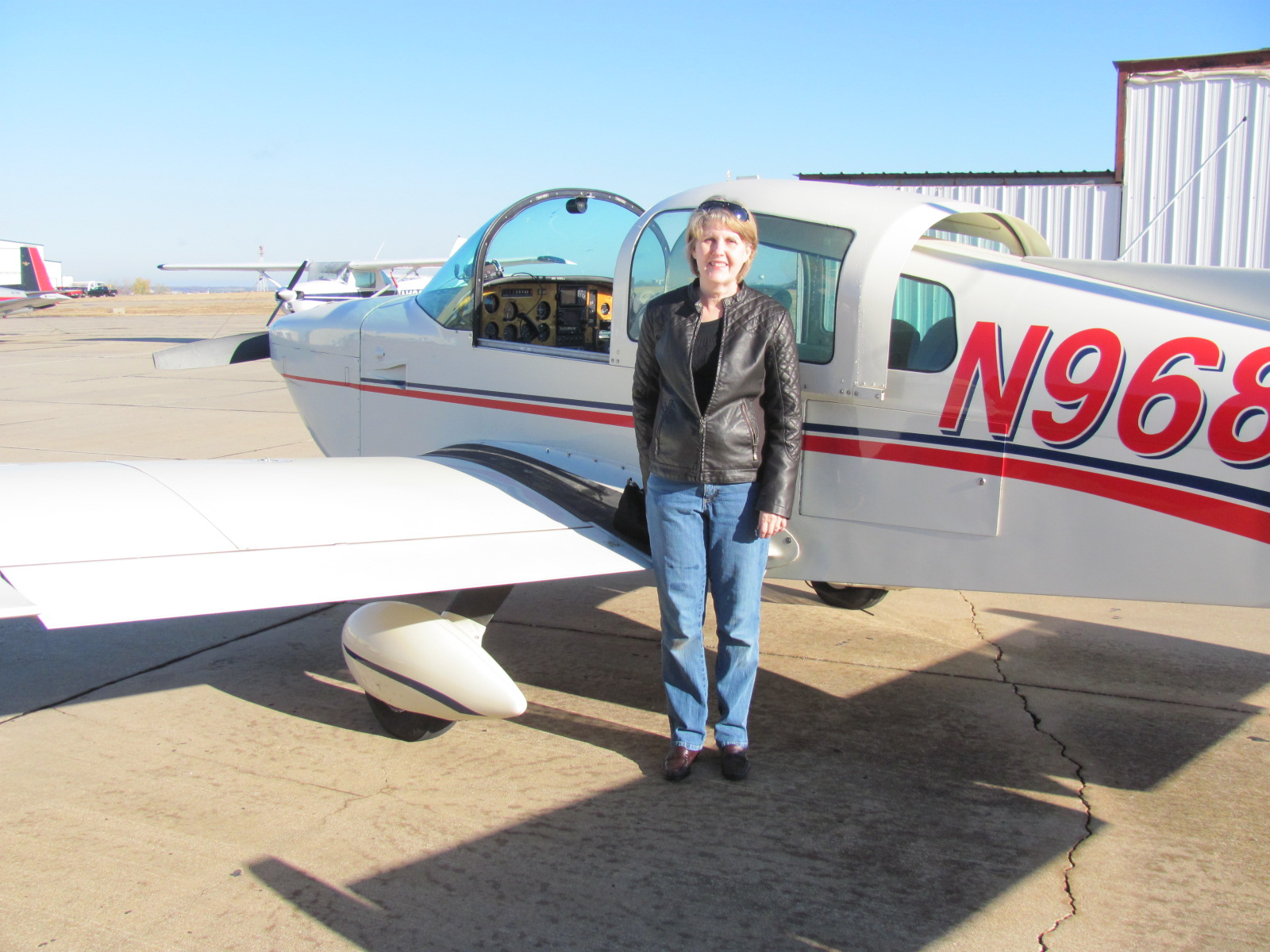
 During the flying lesson, my instructor stresses the word “stabilize”. My touch and go landings look like a drunk weaving down the highway, nausea could easily overtake me. It feels like those occasional gusts of whipping wind that attempts to wipe your car off the road. So “stable” is the word for the day. Stable on downwind, on approaches, on landings, and on take offs. Basically, control the plane a little better. Even when it whips back and forth like a volleyball? Especially then.

 I finally learn to keep my hand on the throttle while flying around the pattern, just in case we get too low, go too fast or, crazy thought, overshoot the runway. Good advice, Glenn.

By the way, in debriefing, he asks if I plan to fly solo. Me, the unstable one? Which, I’m reminded, proves why I need these lessons. But solo? Fly by myself? Take that machine up into the sky alone? By the way, my pilot husband thinks my instructor has found a gold mine, the years it will take to teach me to land, much less ever solo. I think I can pass the medical, but the biggest drawback to flying solo, I learn, besides the thousand hours I need to become “stable”, is passing a written test.  Have you seen the detail in that book? I’m getting familiar with Chapter 1 because I’ve read it about 20 times (not exaggerating) but the next 11 chapters have titles like Procedures and Airport Operations, Flight Instruments, Navigation and Weather Service. What do they think I want to do, become a pilot?

 For the first time, I consider flying solo. Maybe it’s possible, say, ten years from now. At the moment, I’m still trying to get stable.

Me? Land this plane? Lessons #6&7

My flight instructor should have warned me, but it’s good he didn’t. I might not have driven to my lesson today. We do touch and go landings. Me? Yes, me. That means we will land and take off again before coming to a full stop. I thought you had to know much more about flying before doing that. However, our doctor friend in Alaska just flew touch and go’s on his second lesson. Hmm. Does that mean I’m a little …. no, of course not.

Now, Lesson # 6 is not a normal, first-timer, touch and go lesson. We have a hefty crosswind, the wind adamant on blowing us off the runway. We do three landings. That is enough. I offset the crosswind by using left aileron and right rudder, landing on one wheel. At least, I am supposed to do that. Thank you, Glenn, for landing us safely.

The weather for Lesson # 7 is fantastic. Meaning clear skies, no extreme heat or cold and, best of all, no wind.

We escape catastrophe three times (that I know of). My first take off does not look pretty. The plane heads left for the grass instead of going straight down the runway. At least I’m smart enough to know you can’t take off in the grass, so I yell into the headphone, “What do I do?” That’s my crazy mind for you, all jello. Forgot everything I learned. My instructor corrects us at the last minute.

 We follow the flight pattern around the airport and start to land. He explains the steps. Turn on the carburetor heat, reduce speed, put down flaps, announce on the intercom that you’re turning final to land, and don’t let the nose drop too fast. The barbed wire fence comes upon us really quick. I don’t remember it being that close to the runway before. “Keep your nose up.” I hear several times. “Keep your nose up.” I’m grateful he stays calm but without him, we might have seen more of that fence that we wanted to.

 My next take off is good. At least Glenn says so. (Maybe he’s recalling that earlier one.) Come to think of it, I never got a compliment for any landings.

Going along smoothly for our sixth landing, I get too confident and we start to bounce. Not just a little bump, but bungee jumping like at Six Flags. Nose facing the sky does that, I hear. The draft lifts you up into the air again. I don’t like it.

Seventh landing. Glenn says it’s time to quit. Don’t know if he has had enough, or if he sees the sober look on my face. He encourages me by telling me I’m doing better than my very first lesson. Well, I sure hope so. Otherwise, why am I doing this?

For the next few weeks, that’s all we will do. Touch and gos. Except more practice with stalls, naturally. I hope the landings get better, but I’m so glad an instructor is along to correct my mistakes. Otherwise, I might not survive. Wait, isn’t that why I’m taking lessons in the first place? To survive? Or at least to have a chance at survival should I need the expertise? 

 P.S. For some reason I have yet to diagnose, a group of airport maintenance crew and bystanders are casually sitting around the airport lounge every time I disembark. Then they disappear. Surely they can’t see or, heaven forbid, listen to my crazy flying lessons.

After my lesson, I drive a few miles to downtown Guthrie to shop (a way to relax of course) I stop in a drugstore for coffee and a man I don’t know comes up to me and asks if I’ve been flying. I look around. Did I sprout feathers or something? How does he know I just came from the heavens? “Oh, I’m so and so… and your husband told me all about your flying lessons.” Now, I’m certain my prowess, or lack thereof, is slung all over the airport.

However, maybe I’m paranoid. Or perhaps there are not many pilot’s wife’s out for a joy ride with a daring instructor.

What is Love?

Bill’s Wednesday night lesson delved into the question of true love.  It seems we all desire to be truly loved, every last one of us. So, since love is so important, is there an insightful definition that can help us recognize it?

Yes. Here is the best description of love on the planet – taken from II Corinthians Chapter 13.

  • Love is patient
  • Love is kind
  • Love does not envy
  • Love does not boast
  • Love is not rude
  • Love is not self-seeking
  • Love is not easily angered
  • Love keeps no record of wrongs
  • Love does not delight in evil
  • Love rejoices in truth
  • Love always protects
  • Love always trusts
  • Love always hopes
  • Love always perseveres

Love never fails. However, this kind of love (that we all want!) is impossible by ourselves. We fail. God is love, according to I John 4:8, and so if we accept that He matches this definition and He loves us in this way, we can better love others. What an amazing kind of love!

Should we share our food?

“The United States boasts not only the world’s greatest military but also the world’s greatest food basket,” wrote Tony Hall in his book, Changing the Face of Hunger.  “That food could be the most important arsenal for our war against terrorism…”

Tony Hall, a U.S. Representative for more than 20 years, served on the United Nations Agencies for Food and Agriculture,  the World Food Programme, and the International Fund for Agriculture Development. He traveled to Somalia, Haiti, the Sudan, Ethiopia and other places where food is scarce, including the soup kitchens and food banks of America. Emotionally drained by the misery, he was also morally energized. He alerted Congress that it had a responsibility to stop looking the other way.

I just read his book and took out a few quotes: “When we feed hungry people—and help them solve other problems—we create goodwill that can last for generations, cement alliances, and make us safe in an often dangerous world. When it comes to our enemies, if we feed them, we confuse them, soften them, change them. In the long run, it’s a powerful foreign policy to help people in need, even if we don’t get along with them, even if they don’t thank us for it right away. Because they will remember.

“In my travels, I’ve seen that hunger, poverty, and oppression prepare the soil for terrorism. I’ve seen terrorists recruit new followers by feeding, clothing, and educating them. I’ve also seen how we can feed and clothe children at schools that teach freedom and love, instead of letting terrorists feed them at schools that teach hate. Such efforts are sowing the seeds of peace and freedom in many conflict-ravaged places. People won’t attack you if they view you as their friend.”

Hall states in his book that the U.S. provides aid throughout the world, but many don’t know where the food comes from. “I think they should know.”

“There’s no doubt in my mind that humanitarian aid is the most effective weapon we can deploy against terrorism—not only because it can make us look good but also because it can alleviate the poverty and despair that breed terrorists. Terrorist organizations such as al-Qaeda use food and education—or rather miseducation—to recruit new terrorists.

“I’ve observed over the years that the rich do a pretty good job of taking care of themselves. What we need is a lot of people who are committed to taking care of the poor, the middle class, and the blue-collar workers… It’s the right thing to do.”

Isn’t there something in the Bible like that?

Tony Hall seems to understand world hunger better than most.

Flying Lesson #5

I miss a week’s lesson, then two weeks.  Nervous going back to flying. I probably forgot everything the instructor taught me. Hope he doesn’t expect me to know how to land.

Confession time. Last time I flew, we taxied up to take off. Check list done. Radioed. “Guthrie Traffic. Grumman eight nine uniform. Ready for take off 1-6. Guthrie.” Yeah! I did it right. The instructor reached up to close the overhead canopy and it would not lock. After several attempts, he made the dreaded call to “taxi down the runway.” Seems when I unlocked the plane I had locked the canopy back up and we had to shut off the engine and use the key to unlock the canopy before we could take off. How embarrassing. This week, I notice the instructor checks the canopy before we leave the hanger site.

We stay low this time, nearer the ground where I can see the effects of turning. (And closer to crashing, I might add!) We do a rectangular course, follow the road around a square mile—thank you to whoever mapped out so many squares in Oklahoma. I decide that if I miss a corner I can fly another mile and no one will notice. My logic. But the miles do seem much shorter in the air. And some of my turns are much wider than others. Due to the wind, Glenn says. We learn to “crab” into the wind. Crab? Not a sensible aerodynamics term. Sounds like a Cajun word to me.

I learn that the nose of the plane may not be headed directly straight in front of you to go straight. Huh? He explains again. The aircraft nose may be at an angle when heading straight—because of the wind factor. So different than a car. A car goes straight, a plane may not?

Speaking of cars, I finally tell my instructor I was the worst driver in my high school Driver’s Education Class. Ask my nervous classmates. I hit a ditch at every corner, drove off the highway, and ran a car off the road. Glenn says he’s glad I didn’t tell him about my lack of natural ability before we started.

 Next we follow the winding Cimarron River, a natural playground in the air. Like walking on a balance beam, I try to keep the plane from descending or ascending while weaving back and forth. I need practice. Lots of it.

Landing is not as smooth, but then what do I expect? Beginner’s luck again? As we hit the concrete, we head off the runway to the left. My instructor calmly veers us back to the center like it’s a normal everyday landing, not like some raw, inexperienced imbecile is in the cockpit with him.

 Wow. This is more complicated than I thought. Also more fun.

 Postscript #2

My stepson Jason flies with me after my lesson. I think we’re both starting to enjoy it more. (That first lesson was a little tense.) We try the rectangular course and the winding playground so much I get nauseous. He tells me he also gets nauseous on an empty stomach. Him, a seasoned pilot! Makes me feel better anyway. We make it back safely—the flying cut short so I can go to McDonald’s.

 P.S. Maybe I should tell him about my traumatic Driver’s Ed class. Nah.