Estates sales are funny things. I learned as much about people as about Aunt Blanche. Dozens of vintage dresses sold the first hour; young ladies, and women buying for their retro stores. Several arguments ensued. See more at www.blanchetrimble.wordpress.com
Flying to Texas Saturday morning with Bill, a little excitement at 9,000 feet interrupted our normally dull flight. The headset conversation with ground control went something like this.
Ground Control: N Eight Zero Yankee, do you have a camera?
Bill: No sir, I don’t.
Control: You’re going to regret it.
Bill: What have you got, over?
Control: F-15 Eagle coming your way in 6 minutes.
Plane 2: I have a camera.
Control: Sorry, you’re too far away.
Control: Eleven o’clock in two and a half minutes. Just above you. I’d appreciate if you didn’t shoot ‘em down.
Bill: Hear you. Looking but don’t see a thing.
Control: You’re a little faster than I thought. There’s six F-15’s a little behind to your left.
Bill: Yeah! I see four in formation – not six. Roger.
Plane 2: It’s Air Force. Two probably got lost.
Control: You probably didn’t hear but an F15 commented “Radar Contact.”
Bill: Took your advice and didn’t shoot.
Control: Appreciate that. And it was four, not six.
Bill: Glad to help any time, over.
And of course, I don’t have any pictures to show that the F-15’s really passed by!
Glenn, my flight instructor, asks if I’m ready to move to the pilot’s seat. Nope. I choose to stay in the co-pilot seat, for now, at least, since I will hopefully only fly if something happens to my husband. I want to become more confident knowing for sure I can fly from my regular seat, assuming I’m awake, since I usually sleep when my husband flies. Wait, I would be awake if…. Oh, never mind. See, I trust him. It may be more difficult to fly from the right side, however, because it’s hard to see the instruments, like the airspeed indicator, turn coordinator and the altimeter. Yep, I looked it up. That’s in Chapter 3.
I’m pretty consistent at the 1,900 feet altitude this time, which is supposed to help while I learn to take off and land. Clearly, it frees me to focus on whatever the next lesson is to be. I come in too slow on the first landing so have to increase the throttle. The next time I’m too high, reduce throttle, bring nose down. Whoa…bring nose down too much. I discover what happens when you don’t keep the nose up or “flare” enough during landing. Your instructor steps in. Otherwise, I would have hit nose first instead of back wheels first. Not good. Grumman owner hubby would not be happy. Neither would Joey, his partner. Thank you guys for trusting me. Or trusting Glenn.
About this time, I realize I need a bathroom break. No can do. Lesson to myself. Don’t drink a glass of water just before going flying.
The next is a fairly good landing; another one not so good. The sixth time I must have flown too fast, too high, or too something, but that darn plane refuses to hit the ground. Bounces like a yoyo, a string pulls it back into the air. It won’t touch down, almost as if it has a mind of its own. Glenn thinks I haven’t pulled the throttle all the way back. When we finally land nearly three miles down the runway, we’re closer to the end than normal.
Glenn says, “I’ll help you out and do the take off.” He quickly pushes in the carburetor heat, puts up the flaps and gives it the gas. We take off in seconds. I don’t understand his bravery. Why anyone would want to be in the same airplane with me while I’m learning is beyond my understanding. I’m told that you let the plane settle down quietly instead of fighting with it and pushing the nose down.
I’m ready to quit. For obvious reasons. But we continue and finally on the eighth landing, I hear, “That’s enough for today.” I taxi to the hangar and shut down, lock up the airplane, close the hanger door and rush to the bathroom.
Postscript #3
I quit lessons because the plane is scheduled for its annual inspection. Temporarily. Soloing is a possibility. If I can take 10 lessons, maybe I can fly alone someday. The possibility of flying to Texas anytime I want is tempting. But at this rate, it may take a couple of years.
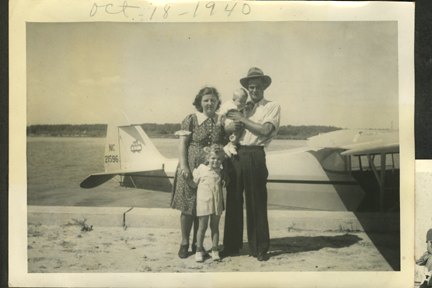
An old picture of my husband as a baby with his Grandparents.
Correction: My husband was not born in 1940. This is his mother and his grandparents.
It’s a beautiful, clear, crisp morning in Oklahoma. Very little wind. Five knots. We leave from runway 1-6. I announce runway 3-4, but get corrected pretty quickly. For the Guthrie Edmond Regional Airport, the pattern altitude is 1,900 feet, meaning I should stay near that height while flying around the airport. Crosswind, downwind, base and final in one big rectangle. However, my six touch and go landings around the flight pattern vary from 2,100 feet up to 2,600 or so. My plane seems to thrive on rising above that ideal 1,900 feet. I don’t worry. The greater air cushion keeps me safer, right? Of course, maybe that’s why my landings are just as varied as my flying. Because for some reason the ground is still in the same place.
My flight instructor said we had a great flight. He said any time we can walk away from a flight, it’s a good one. And any time we can use the plane again, it’s a great flight. So, yes, we had a great flight.
He also insists that consistency will help me. Consistency, meaning staying at the 1,900 feet. Oh. Well, guess I can’t quit flying yet. Still have things to learn. So, tell all my friends to keep praying, I’m still up in the air.
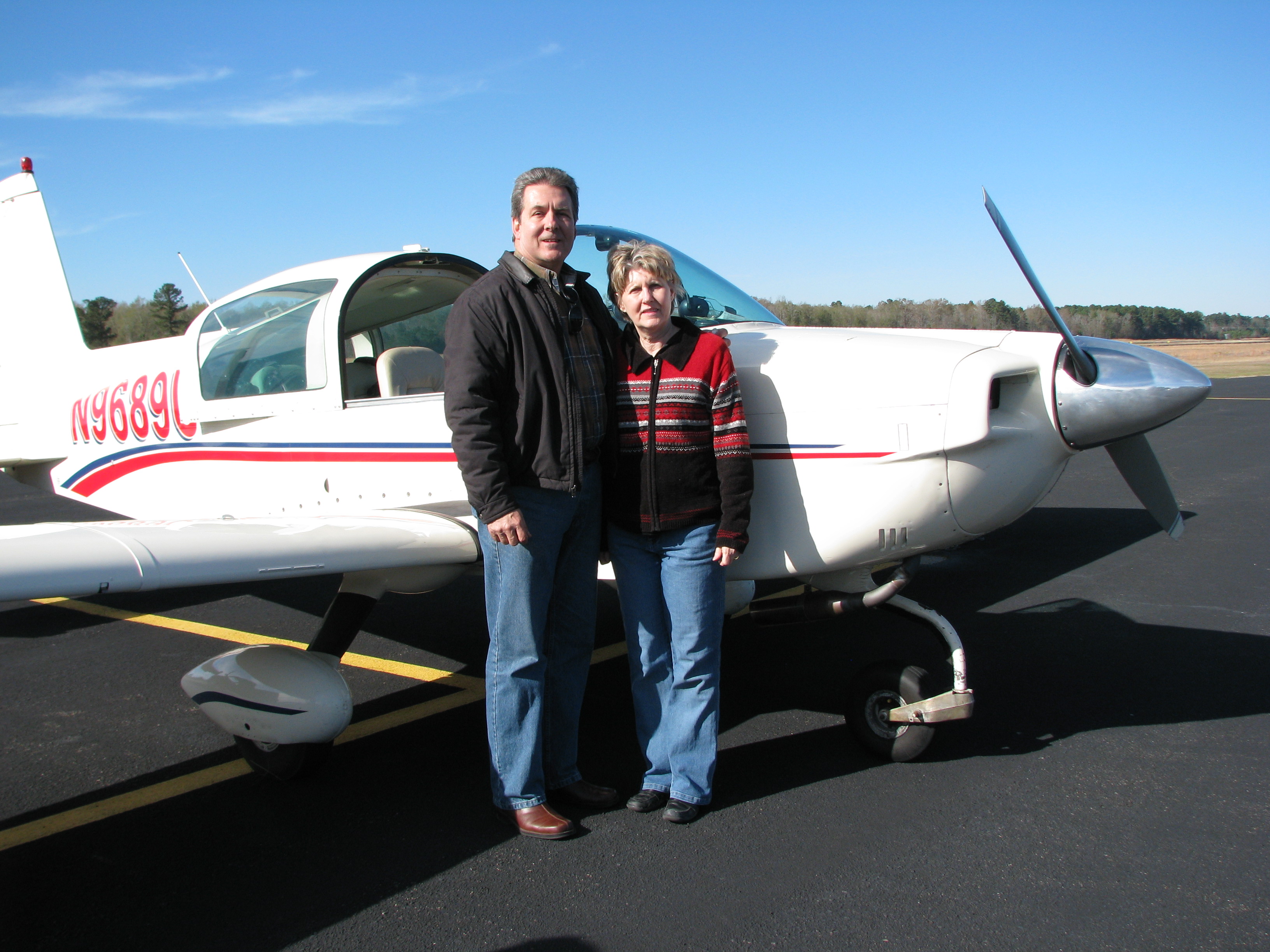
I added a pic of my husband and I getting ready for a flight. So much fun! But then, he’s the one flying that day!
Our flight in Bill’s Piper Twin engine Comanche to San Antonio was nondescript. By that I mean, I slept the whole way. Something about the hum of the engine and the monotonous clear sky makes me snooze. And, of course, I trust his flying expertise.
But our time in San Antonio, the city of a European/Southwestern-style, romantic river walk, was a different matter. I came down with a 24 hr virus and spent most of our time in the sleek hotel room perched over the toilet. Not good since we only stayed one day. Bill accused me of passing the poison to him even before I recovered. He worried about the sickness attacking while flying to Carthage, Texas. I admit the thought of having your pilot’s head stuck in a bag while 7,000 feet in the air did not appeal to me, but I figured we had about 12 hours before the thrust of the enemy struck him down, and during this window we could fly to our next destination, a one and ¾ hour flight. We took off.
Since an emergency hovered on the horizon, Bill decided I needed a quick lesson on how to fly the plane in case of a pilot’s temporary incapacity. Although I’ve had a few hours of lessons, this airplane was bigger and, I noticed, had a hundred times more gadgets. Here’s some of my pages of notes. Most importantly – DON’T PANIC.
Lesson #1. Leave the autopilot on as long as possible. If it’s flying great, don’t jump in and mess it up. Get your bearings first. Call in to notify ground control.
Lesson #2. Before I take the plane off autopilot, I can do this: 1) Move mixture forward-red levers–never, ever all the way back toward you! The engine will die. 2) Move the prop RPM forward-blue levers, 3) Pull back manifold pressure or power-white/gray levers- to 17 inches, 4)Put down landing gear when the airspeed gets down to 150 mph, and 5) check gasoline – change to main tanks. There are 3 tanks on each wing in this twin: tips, auxiliary, and mains; main should have the most fuel. Do this now in case I forget later in all the excitement.
Lesson #3. Now, to change directions – possibly following instructions over the headset. Hit the autopilot mode indicator button on the top of the panel and it will change to heading. HDG. Change the direction on the heading bug and the plane will automatically turn to that course. Wow! This is much easier to turn than the Grumman!
Lesson #4. To start descending. Push altitude hold button on the auto pilot panel to disengage altitude hold. ALT. Move the pitch wheel to the down position. DN. (Slighty move it up). DN. This should start the plane on a gradual descent. Watch the speed to make sure we don’t go down too fast which we definitely don’t want to do. If so, then adjust pitch wheel. Stay around 100 mph. Level off no lower than about 1,000 feet. Watch your speed. If it gets below 100 mph, add a little power. I can do this.
Lesson #5. Get ready to land. This is the hard part but I have to stay calm. Line the plane up with the runway. Put the flaps down. Trim the nose if needed.
Lesson #6. Land. Pull power back. Keep nose up. Pull power all the way back when over the runway. Touch down!
And remember, I can shove in the power and go around again, if I so desire. This is all assuming I know what the above mentioned terms and gadgets do.
Hopefully, if this emergency occurs, by this time my husband will have taken his head out of the sick bag to observe my excellent landing, and thank me for saving his life.

 It’s a beautiful, clear, crisp morning in Oklahoma. Very little wind. Five knots. We leave from runway 1-6. I announce runway 3-4, but get corrected pretty quickly. For the Guthrie Edmond Regional Airport, the pattern altitude is 1,900 feet, meaning I should stay near that height while flying around the airport. Crosswind, downwind, base and final in one big rectangle. However, my six touch and go landings around the flight pattern vary from 2,100 feet up to 2,600 or so. My plane seems to thrive on rising above that ideal 1,900 feet. I don’t worry. The greater air cushion keeps me safer, right? Of course, maybe that’s why my landings are just as varied as my flying. Because for some reason the ground is still in the same place.